Key takeaways
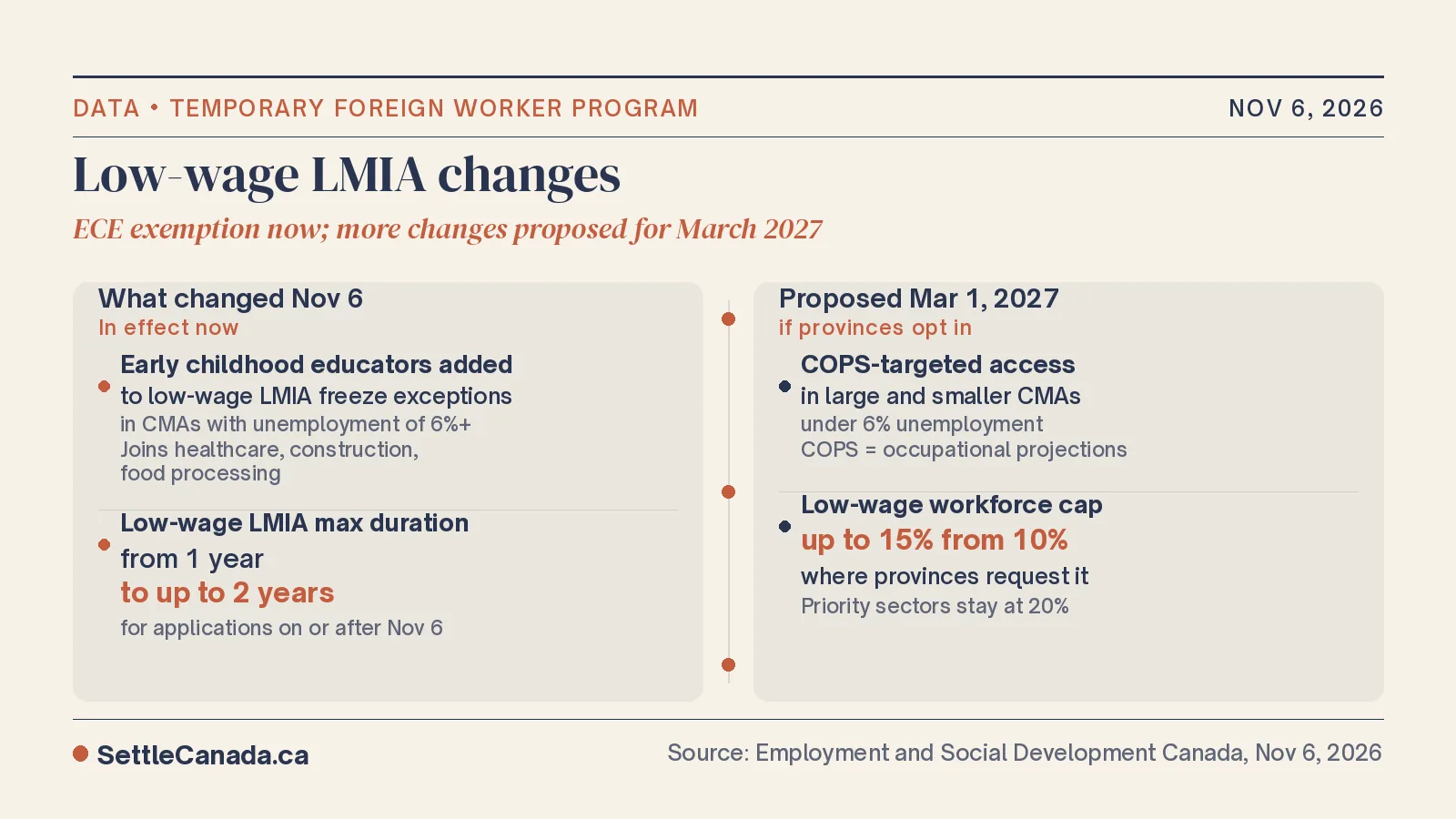
- From November 6, 2026, early childhood educators are added to the exceptions to the low-wage LMIA freeze
- The freeze applies in Census Metropolitan Areas (CMAs) with unemployment of 6% or higher
- Low-wage Stream LMIA applications submitted on or after November 6, 2026 can have a maximum duration of up to 2 years, up from 1 year
- More changes are proposed for March 1, 2027 and depend on provinces and territories opting in
- Budget 2026 includes $151.5 million over five years for TFWP service delivery
Early childhood educators added to the exceptions
The ESDC news release says that, effective November 6, 2026, early childhood educators are added to the list of exceptions. LMIA applications in the Low-wage Stream can be processed in CMAs with unemployment of 6% or higher for this group.
Existing exceptions to the freeze already include healthcare, construction and food processing. ECE is newly added.
LMIAs can last up to 2 years
| Item | Before | Applications submitted on or after November 6, 2026 |
|---|---|---|
| Maximum LMIA duration, Low-wage Stream | 1 year | Up to 2 years |
Proposed for March 1, 2027
Further Low-wage Stream changes are proposed for March 1, 2027. They depend on provinces and territories opting in. They include:
- access targeted by Canadian Occupational Projection System (COPS) in large CMAs with lower unemployment, and in rural areas of large CMAs and smaller CMAs
- full occupational access remaining in rural communities
- allowing provinces and territories to request a raise of the low-wage workforce cap from 10% to 15% for eligible employers. Priority sectors stay at the existing 20% limit
These are proposals, not final rules.
Funding in Budget 2026
- $151.5 million over five years to support and enhance TFWP service delivery.
- $82 million over four years for the Migrant Worker Support Program.
Related coverage
See our earlier report on the low-wage LMIA CMA list. This change is a new exemption and a new duration, not a repeat of that list.
What this means for you
- You are an employer hiring early childhood educators: the ESDC release says LMIA applications for this group can be processed in high-unemployment CMAs. Read the release for details.
- You are a worker in the Low-wage Stream: LMIAs submitted on or after November 6, 2026 can be for up to 2 years. Your own permit depends on your employer’s LMIA and on IRCC.
- You work in another occupation: the March 2027 changes are proposed and depend on your province or territory.
These rules apply to employers and the LMIA. They do not guarantee a work permit.
What to do next
- Read the ESDC news release and the TFWP pages for the Low-wage Stream.
- Ask your employer whether a new LMIA application is planned.
- See our work permits guide and low-wage LMIA CMA list report.
Frequently asked questions
What changed on November 6, 2026?
Early childhood educators were added to the exceptions to the low-wage LMIA freeze, and the maximum Low-wage Stream LMIA duration rose from one year to up to two years.
Where does the freeze apply?
In CMAs with unemployment of 6% or higher.
Are the March 1, 2027 changes final?
No. They are proposed and depend on provinces and territories opting in.
Does a 2-year LMIA give me a 2-year work permit?
The release describes LMIA duration. Work permit decisions are made by IRCC.
Sources
Facts as provided in our research brief dated November 9, 2026.
This is general information, not legal or immigration advice. For your situation, consult a licensed immigration consultant (RCIC) or lawyer.
