Key takeaways
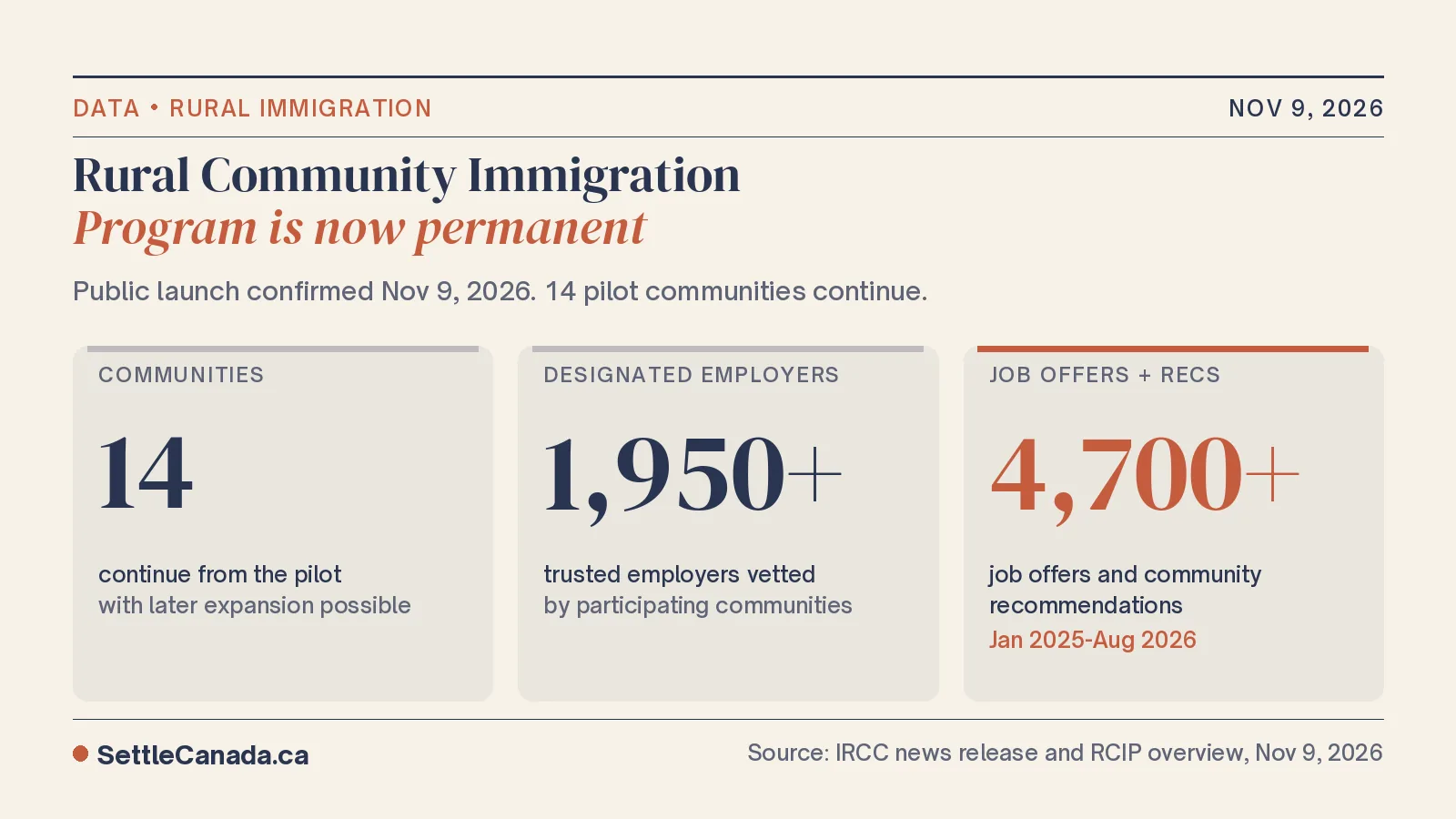
- IRCC announced on November 9, 2026 that the Rural Community Immigration Pilot is now a permanent program
- The 14 current pilot communities are expected to continue, with more communities planned in the future
- From January 2025 to August 2026, communities designated more than 1,950 employers, and those employers issued over 4,700 job offers and community recommendations
- A community can apply if its population is under 200,000 and it scores 0.20 or higher on the Statistics Canada Index of Remoteness
What IRCC announced
IRCC says the Government of Canada has made the pilot a permanent program, in its news release of November 9, 2026. The program continues the pilot's community-driven priority setting and designated-employer model. It also keeps the stronger integrity measures, including mandatory employer training and monitoring and reporting.
The 14 communities
The program overview lists these communities as expected to take part:
| Province | Communities |
|---|---|
| Nova Scotia | Pictou County |
| Ontario | North Bay, Sudbury, Timmins, Sault Ste. Marie, Thunder Bay |
| Manitoba | Steinbach, Altona/Rhineland, Brandon |
| Saskatchewan | Moose Jaw |
| Alberta | Claresholm |
| British Columbia | West Kootenay, North Okanagan Shuswap, Peace Liard |
Who counts as a rural community
Communities can apply during an expression of interest process. They need a population under 200,000 and a score of 0.20 or higher on the Statistics Canada Index of Remoteness.
Pilot results
- From January 2025 to August 2026, participating communities vetted and designated more than 1,950 trusted employers.
- Those employers issued over 4,700 job offers and community recommendations.
- The earlier Rural and Northern Immigration Pilot (2019 to 2024) had more than 2,800 employers take part. More than 12,500 candidates and their families were admitted.
- This year's Immigration Levels Plan targets 5,500 admission spaces for the permanent program. This is not a new Levels announcement.
What this means for you
- You live or plan to work in one of the 14 communities: check the community's own page for how to find a designated employer.
- You live somewhere else: new communities are planned, but IRCC has not given a date in these documents.
What to do next
- Read the IRCC news release and overview.
- See our earlier report on the permanent class and our Provincial Nominee Program guide.
- Check your points with our CRS calculator if you also use Express Entry.
Frequently asked questions
Is the Rural Community Immigration Program permanent?
Yes. IRCC announced this on November 9, 2026.
How many communities take part?
14 communities are expected to continue, with more planned in the future.
What makes a community rural?
A population under 200,000 and an Index of Remoteness score of 0.20 or higher.
Does this change anything for Atlantic Immigration Program applicants?
These IRCC pages do not claim any change to the Atlantic Immigration Program.
Sources
- IRCC: Canada creates a permanent immigration pathway to help rural communities
- IRCC: Overview of the Rural Community Immigration Program
Facts as provided in our research brief dated November 9, 2026.
This is general information, not legal or immigration advice. For your situation, consult a licensed immigration consultant (RCIC) or lawyer.
