Key takeaways
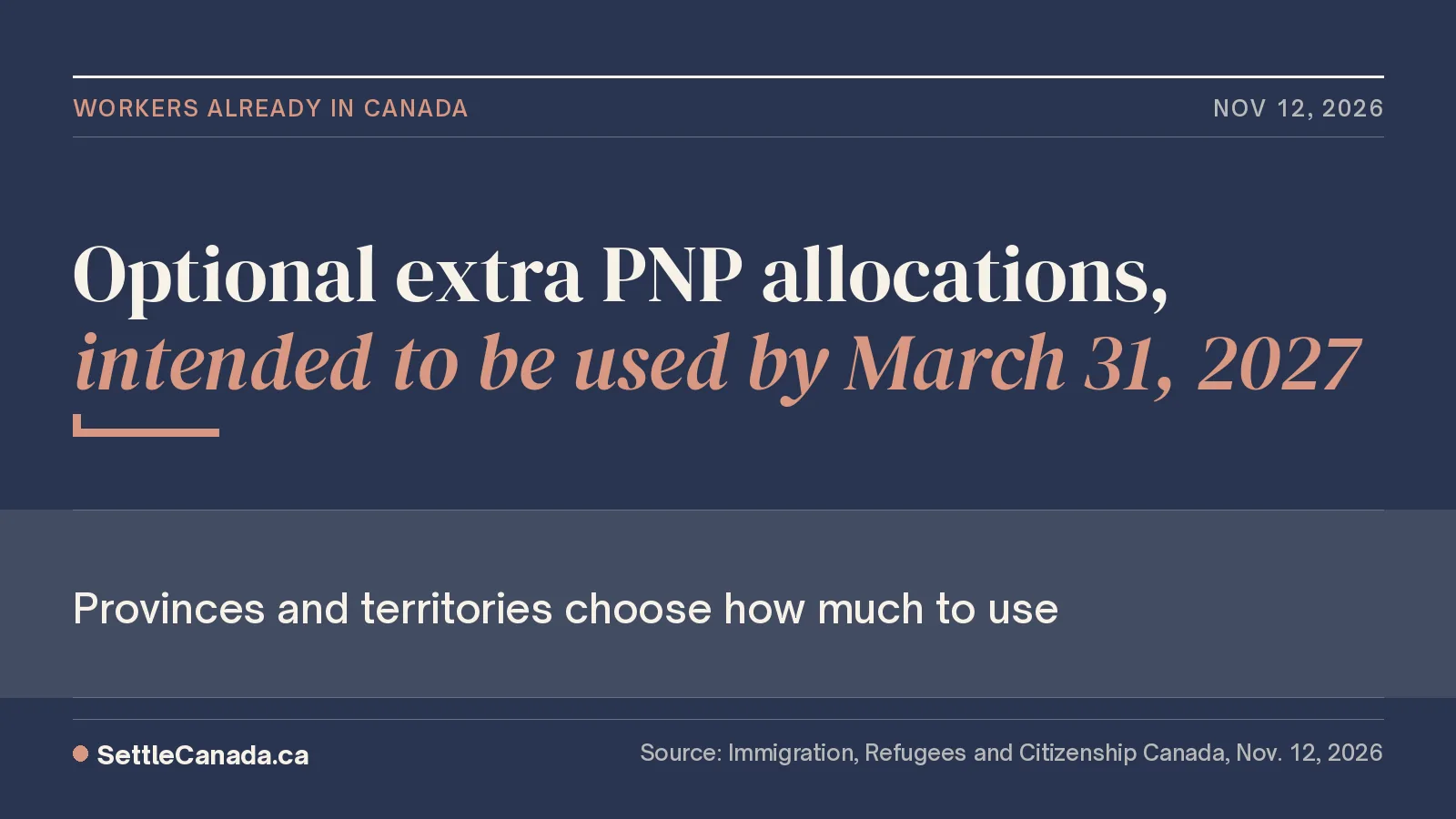
- IRCC is offering provinces and territories optional extra PNP allocations for up to a combined 100,000 workers already in Canada, and their families
- The allocations are intended to be used by March 31, 2027, to support transitions to PR in 2027
- Each province and territory chooses how much of the extra space to use
- This does not create new programs or re-open closed pathways
- It is not a guarantee of a nomination or PR
What IRCC announced
IRCC’s November 12, 2026 news release says provinces and territories will be offered additional PNP allocations. They can choose how much of this space to use for workers who are established in their communities and meeting their labour market needs.
| Item | What IRCC says |
|---|---|
| Who | Workers already living in Canada, and their families |
| Size | Up to a combined total of 100,000 in 2027 |
| Mechanism | Optional, additional PNP allocations |
| Intended use-by date | March 31, 2027 |
| Who decides how much to use | Each province and territory |
Workers who already applied
IRCC says provinces and territories will also be able to identify workers in their jurisdictions who have already applied for PR and are waiting for a decision. This includes applicants through:
- the Atlantic Immigration Program
- federal programs and pilots that are closed to applications: the Start-up Visa Program, the Self-Employed Persons Program, the Agri-Food Pilot and the home care worker programs
What the measure does not do
- It does not create new programs or re-open closed pathways.
- IRCC says applicants do not need to do anything or contact IRCC for their applications to be processed under these additional spaces. This applies to people who already have an application.
- It is not a guarantee of a nomination or PR.
- IRCC says this measure is separate from the In-Canada Worker Initiative announced in Budget 2025.
Context: what is new
IRCC already announced a workers measure of up to 100,000 in the Budget 2026 and Levels Plan material. See our Levels Plan story and our stream tables story. The 100,000 total is not new. The new detail in this release is that the extra PNP space is optional for provinces and territories, and that it is intended to be used by March 31, 2027.
This release does not add Express Entry spaces. For other 2027 measures, see our Hong Kong and Ukraine story.
What this means for you
- You are a worker in Canada with a PR application already in process (for example under the Atlantic Immigration Program): IRCC says you do not need to contact it.
- You are another worker in Canada: use of the extra space is a provincial or territorial decision. Watch your province’s or territory’s official PNP channels for any steps it announces.
- You are outside Canada: this release is about workers already in Canada.
What to do next
- Read the IRCC release.
- Check the official PNP website of the province or territory where you work.
- Read our guide to the Provincial Nominee Program and see recent PNP draws.
Frequently asked questions
How many workers could be supported?
IRCC says up to a combined total of 100,000 workers and their families in 2027.
When are the extra PNP allocations intended to be used?
By March 31, 2027.
Does this open a new pathway?
No. IRCC says the measures do not create new programs or re-open closed pathways.
Do I need to contact IRCC?
IRCC says applicants do not need to do anything or contact IRCC for their applications to be processed under these additional spaces. This is about applications already submitted.
Is a nomination guaranteed?
No. Provinces and territories choose how much of the extra space to use.
Sources
- IRCC news release: Minister Metlege Diab highlights how Canada is working with provinces and territories to support worker retention (November 12, 2026)
- IRCC backgrounder: Building a stronger Canada through a well-managed, predictable immigration system
- IRCC: Immigration system measures
Facts as provided in our research brief dated November 12, 2026.
This is general information, not legal or immigration advice. For your situation, consult a licensed immigration consultant (RCIC) or lawyer.
